

How Could Spaniards Obtain Encomiendas
Equally Europeans traversed the Atlantic, they brought with them plants, animals, and diseases that changed lives and landscapes on both sides of the ocean. These two-manner exchanges between the Americas and Europe/Africa are known collectively as the Columbian Commutation (Figure).
Of all the commodities in the Atlantic World, sugar proved to exist the virtually important. Indeed, sugar carried the aforementioned economic importance as oil does today. European rivals raced to create sugar plantations in the Americas and fought wars for command of some of the all-time sugar production areas. Although refined sugar was available in the Quondam World, Europe'due south harsher climate made sugarcane difficult to grow, and it was not plentiful. Columbus brought sugar to Hispaniola in 1493, and the new crop was growing there by the finish of the 1490s. Past the first decades of the 1500s, the Spanish were building carbohydrate mills on the island. Over the adjacent century of colonization, Caribbean islands and nigh other tropical areas became centers of saccharide production.
Though of secondary importance to carbohydrate, tobacco achieved swell value for Europeans as a cash ingather likewise. Native peoples had been growing it for medicinal and ritual purposes for centuries earlier European contact, smoking information technology in pipes or powdering it to use every bit snuff. They believed tobacco could ameliorate concentration and enhance wisdom. To some, its use meant achieving an entranced, altered, or divine state; entering a spiritual place.
Tobacco was unknown in Europe earlier 1492, and information technology carried a negative stigma at first. The early Spanish explorers considered natives' employ of tobacco to exist proof of their savagery and, because of the fire and smoke produced in the consumption of tobacco, bear witness of the Devil's sway in the New Globe. Gradually, however, European colonists became accepted to and even took up the habit of smoking, and they brought it across the Atlantic. Every bit did the Indians, Europeans ascribed medicinal backdrop to tobacco, challenge that it could cure headaches and skin irritations. Withal, Europeans did not import tobacco in smashing quantities until the 1590s. At that time, it became the first truly global commodity; English, French, Dutch, Spanish, and Portuguese colonists all grew information technology for the globe marketplace.
Native peoples also introduced Europeans to chocolate, made from cacao seeds and used by the Aztec in Mesoamerica as currency. Mesoamerican Indians consumed unsweetened chocolate in a drink with chili peppers, vanilla, and a spice called achiote. This chocolate drink—xocolatl—was part of ritual ceremonies like marriage and an everyday item for those who could afford information technology. Chocolate contains theobromine, a stimulant, which may be why native people believed it brought them closer to the sacred globe.
Spaniards in the New World considered drinking chocolate a vile practise; 1 called chocolate "the Devil's vomit." In time, nevertheless, they introduced the potable to Spain. At offset, chocolate was bachelor only in the Spanish court, where the aristocracy mixed information technology with sugar and other spices. Afterwards, as its availability spread, chocolate gained a reputation every bit a love potion.

Visit Nature Transformed for a drove of scholarly essays on the environs in American history.
The crossing of the Atlantic by plants similar cacao and tobacco illustrates the ways in which the discovery of the New World changed the habits and behaviors of Europeans. Europeans changed the New World in turn, not to the lowest degree by bringing Old Globe animals to the Americas. On his 2nd voyage, Christopher Columbus brought pigs, horses, cows, and chickens to the islands of the Caribbean area. Later explorers followed adjust, introducing new animals or reintroducing ones that had died out (like horses). With less vulnerability to disease, these animals often fared better than humans in their new domicile, thriving both in the wild and in domestication.
Europeans encountered New Globe animals also. Because European Christians understood the world as a place of warfare betwixt God and Satan, many believed the Americas, which lacked Christianity, were dwelling house to the Devil and his minions. The exotic, sometimes bizarre, appearances and habits of animals in the Americas that were previously unknown to Europeans, such as manatees, sloths, and poisonous snakes, confirmed this association. Over fourth dimension, nonetheless, they began to rely more on observation of the natural world than solely on scripture. This shift—from seeing the Bible as the source of all received wisdom to trusting observation or empiricism—is one of the major outcomes of the era of early globalization.
Travelers betwixt the Americas, Africa, and Europe also included microbes: silent, invisible life forms that had profound and devastating consequences. Native peoples had no immunity to diseases from across the Atlantic, to which they had never been exposed. European explorers unwittingly brought with them chickenpox, measles, mumps, and smallpox, which ravaged native peoples despite their attempts to treat the diseases, decimating some populations and wholly destroying others (Figure).
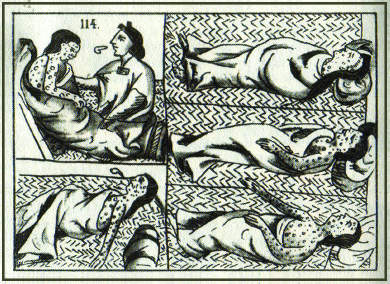
In eastern N America, some native peoples interpreted expiry from affliction every bit a hostile human activity. Some groups, including the Iroquois, engaged in raids or "mourning wars," taking enemy prisoners in order to assuage their grief and supercede the departed. In a special ritual, the prisoners were "requickened"—assigned the identity of a dead person—and adopted by the bereaved family to accept the place of their dead. As the cost from affliction rose, mourning wars intensified and expanded.

How Could Spaniards Obtain Encomiendas,
Source: https://opened.cuny.edu/courseware/lesson/317/overview
Posted by: huntimeneg.blogspot.com
0 Response to "How Could Spaniards Obtain Encomiendas"
Post a Comment